A technical health check for a startup acceleration platform
Mad Devs conducted an independent technical audit of a digital platform that supports startup acceleration programs. The review gave a structured view of the platform’s technical condition across five areas, together with a prioritized roadmap of around 30 recommendations.
Overview
Accelerate Prosperity is a global initiative of the Aga Khan Development Network that supports early-stage businesses and small and growing companies across Central and South Asia through financing, business coaching, mentoring, and technical assistance. Its Virtual Accelerate platform helps accelerators and incubators manage applicants and mentors, track startup progress, and report on program outcomes.
The platform supports investment cases and reporting, startup selection and program management, educational courses, progress tracking, communications, and online events. It also includes a multilingual interface and role-based access across organizations and branches. Several thousand users were registered at the time of the audit.
As part of its annual technical reviews of portfolio companies, Accelerate Prosperity engaged Mad Devs to assess the platform’s architecture, security, development practices, operational continuity, and third-party dependencies.
Mad Devs’ CTO and CIO led the assessment. They reviewed the product and its supporting systems, then translated technical observations into a report with recommendations grouped into four priority levels. The assessment found that the platform was operational and resilient for its current user base, while identifying areas that required attention as the product continued to develop.
Project at a glance
5 areas
Architecture, security, software delivery, business continuity, and third-party agreements
40+ observations
Findings documented across the audit scope
~30 recommendations
Actions grouped into four priority levels
1000+ users
Registered on the platform at the time of the review
The challenge
Accelerate Prosperity needed an independent technical view of a portfolio product that combined several business-critical workflows in one platform. Virtual Accelerate (VA) served different user groups and organizations, from startups and mentors to investors and program administrators. Its functionality included investment tracking, educational programs, application review, reporting, communications, and event coordination.
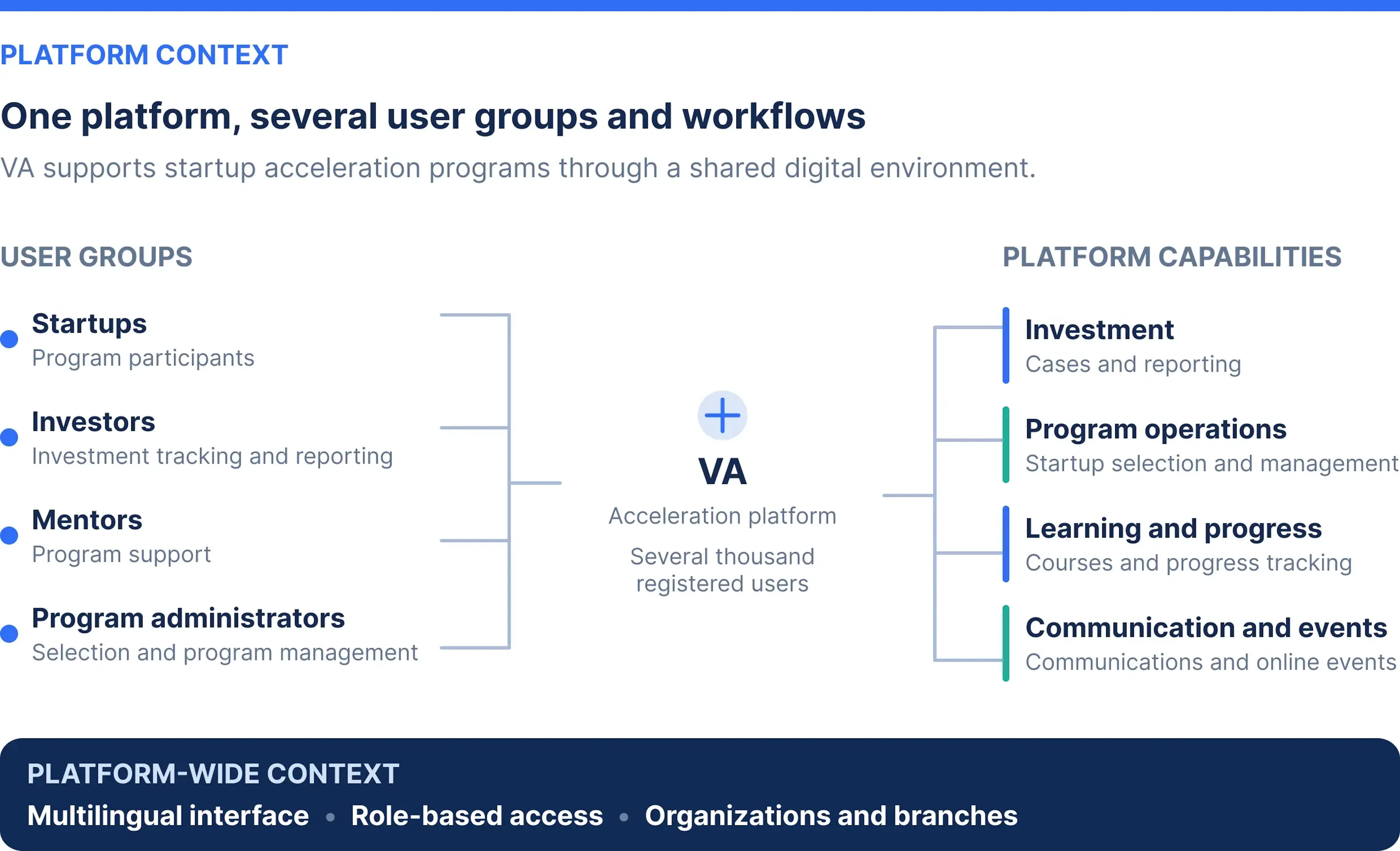
A review limited to code quality would not give Accelerate Prosperity a complete picture. The assessment also needed to consider how the platform was hosted and monitored, how the team developed and tested changes, how the organization handled backups and recovery, and whether third-party software and provider agreements introduced additional risk.
Accelerate Prosperity therefore asked Mad Devs to examine five areas:
- Architecture, infrastructure, and scalability: the product’s structure and its capacity to support current and future use.
- Security and data protection: IT policies, security protocols, access control, and safeguards for data.
- Software delivery: the software development life cycle, quality assurance, and DevOps practices.
- Business continuity: backups, recovery, and the ability to maintain or restore operations.
- Third-party dependencies: software licenses, vendor agreements, and hosting-provider contracts.
How Mad Devs conducted the audit
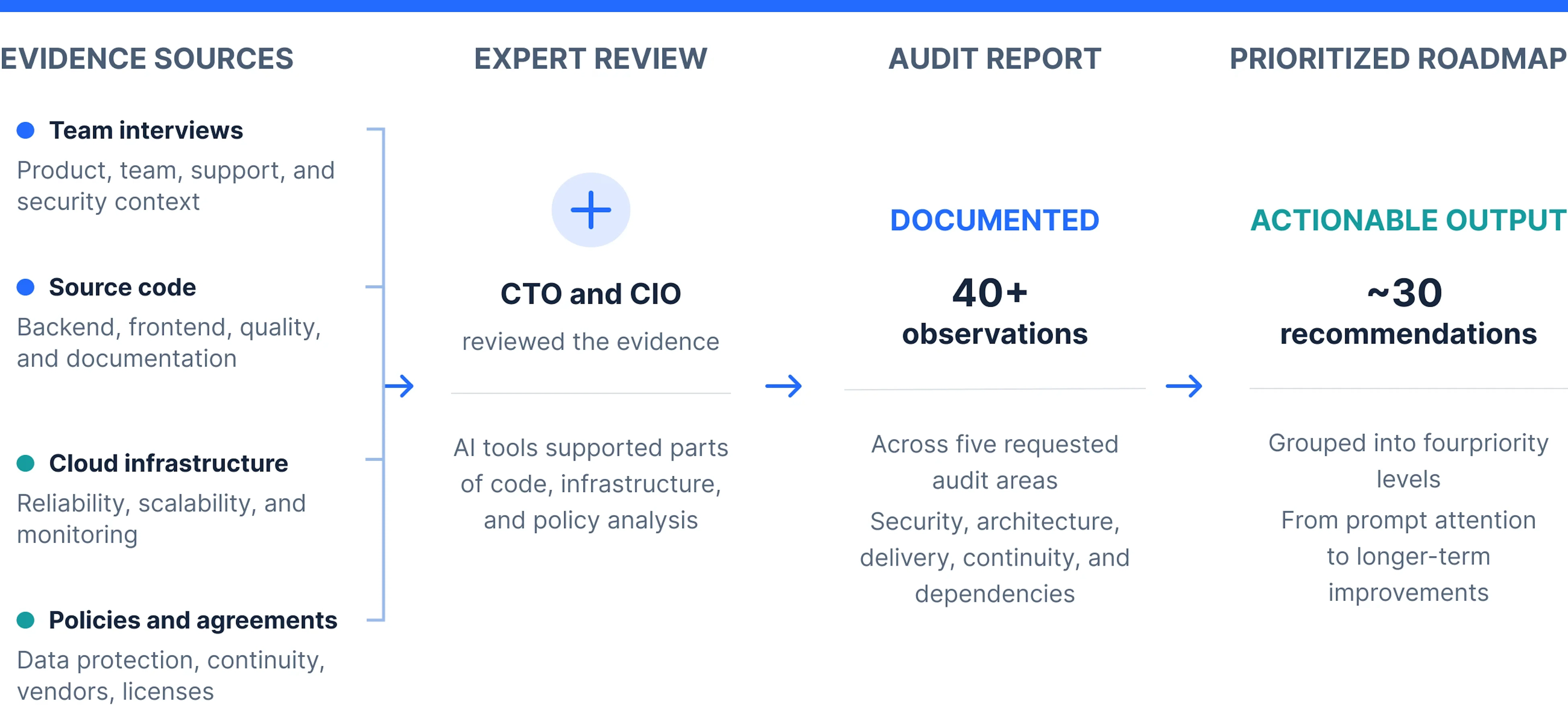
The audit was led by Mad Devs’ CTO and CIO. Accelerate Prosperity provided access to the product, read-only access to its repositories, a working chat with the development team, and time for interviews. This allowed the auditors to compare how the platform was designed with how it was developed, deployed, and supported.
AI tools helped process the volume of documentation, interview transcripts, and code, and flagged areas for closer review. Mad Devs’ experts checked those signals against source materials, investigated relevant findings, and determined their significance and priority. The Delivery Manager coordinated the audit, facilitated sessions with the client’s team, and assembled the final report.
The work moved through five connected stages:

Interviews with the project team
The auditors shared questions in advance and used interviews to understand the product’s history, architecture, development workflows, support practices, and approach to security.

Source code review
The team conducted an expedited expert review of the codebase, focusing on architecture, code quality, and documentation. The review covered the backend, frontend application, and public-facing landing page.

Infrastructure analysis
Mad Devs examined the platform’s cloud infrastructure, including its reliability and scalability, configuration and security, automation, and monitoring.

Review of policies, processes, and agreements
The assessment covered data protection, backups, business continuity, third-party software licenses, vendor arrangements, and hosting-provider terms.

Findings and recommendations
The auditors consolidated their findings into a report covering all five areas. Recommendations were organized into four priority levels so Accelerate Prosperity and the product team could distinguish immediate concerns from longer-term improvements.
AI tools supported parts of the code, infrastructure, and policy analysis. Mad Devs’ CTO and CIO reviewed the evidence and formulated the final conclusions and recommendations.
What the audit found
The review documented more than 40 observations across the assessment scope. The findings were concentrated in three broad groups:
| Area | Observations documented |
|---|---|
| Backend and frontend code security | 20+ |
| Processes, documentation, testing, and business continuity | 10+ |
| Architecture, scalability, and DevOps | Around 10 |
| Third-party software licenses | Several, including one assessed as high risk |
The audit also confirmed positive aspects of the product’s current state. Virtual Accelerate was operational for its existing audience and used a client-server architecture with a clear separation between the frontend and backend. The report gave Accelerate Prosperity a way to consider those strengths alongside the risks and gaps that could affect future development, security, or continuity..
The case study does not disclose individual vulnerability details or license names, keeping sensitive audit findings confidential while outlining the areas reviewed.
Results
Accelerate Prosperity received an independent assessment of Virtual Accelerate across all five requested areas, along with a practical basis for planning follow-up work.
- A review of the product’s technical condition by area.
- A consolidated view of security, scalability, software delivery, and business continuity risks.
- An assessment of third-party software licenses and related legal exposure.
- Around 30 recommendations organized into four priority levels, from issues requiring prompt attention to longer-term improvements.
This format helped turn a broad technical review into a decision-making tool. Accelerate Prosperity could see which findings called for earlier action, which could be planned over time, and how technical risks related to the platform’s continued operation and development.
The client responded positively to the audit results. The brief indicates that recommendations were being implemented; this point, along with any client quote, should be confirmed with AP before publication.
A clearer basis for technical decisions
For Accelerate Prosperity, the value of the review was a consolidated technical picture of a multi-purpose platform, with recommendations organized so leadership and the product team could plan what to address first. For Virtual Accelerate, the assessment recognized that the platform was working for its current user base while documenting the issues that warranted attention across security, delivery, infrastructure, and continuity.
A focused audit can help investors and product leaders understand the condition of a software product, identify risks across more than its codebase, and set priorities for follow-up work. Mad Devs brings CTO and CIO-level expertise to technical assessments of product architecture, infrastructure, security, and engineering operations.
Meet the team

Pavel Zverev
Chief Technology Officer

Andrew Sapozhnikov
Chief Information Officer

Maksim Pankov
Delivery manager


